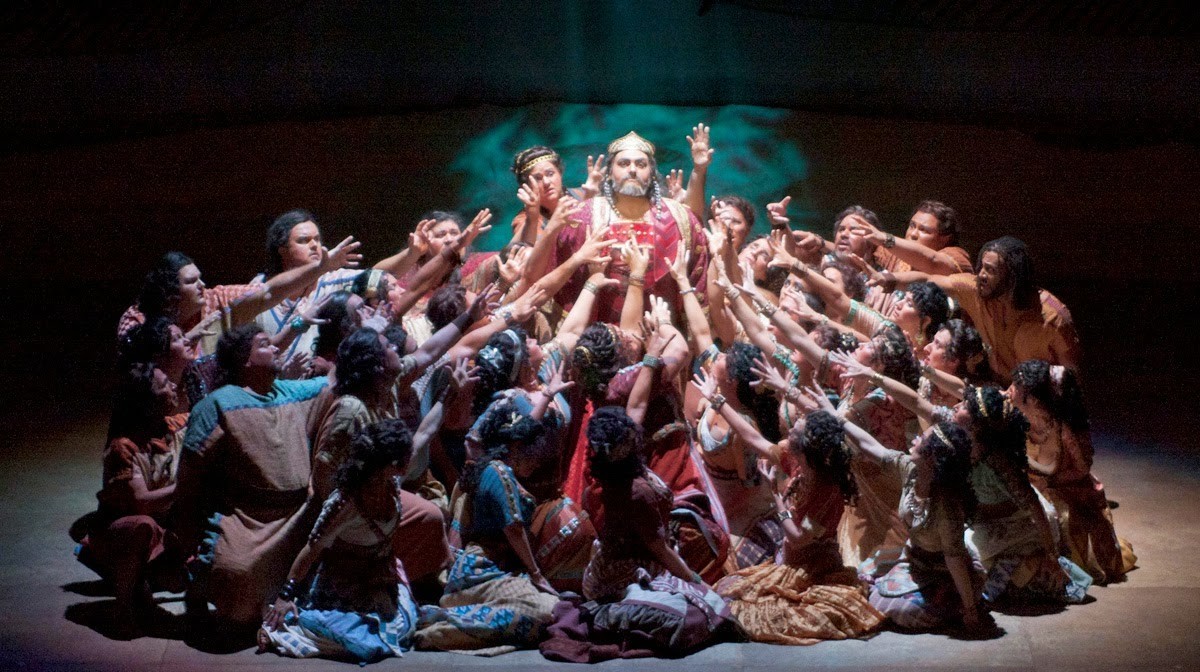
Performed in Italian (with synchronised Russian supertitles )
World premiere: 29 Jan 1781 Cuvillies-Theater, Munich
Premiere of this production: 13 Feb 2009
The performance has 1 intermission
Running time: 2 hours 55 minutes
Marking 270 years since the birth of Wolfgang Amadeus Mozart. Marking 245 years since the world premiere
“The music of my opera is for people of any description, except those with excessively protruding ears,” Wolfgang Amadeus Mozart wrote to his father Leopold with pride about Idomeneo. And yet the destiny of this opera was to prove far from simple: the successful premiere in 1781, subsequent numerous productions in the 19th century… and the disappointed verdicts of connoisseurs made in the early 20th century the music is brilliant, but the traditional genre of Italian opera semi-seria had become hopelessly outdated. It was only in the latter half of the last century that the revival of Idomeneo began, and by our own time it had returned to theatres. The legend of the King of Crete, who had almost sacrificed his only won to the God Poseidon, was interpreted as a psychological drama and as an ancient tragedy, as a moral parable, as a play about the conflict of generations, as a surrealist performance about the interrelations of mortals with the otherworldly, as a hot political pamphlet…
Idomeneo is one of Mozart’s most courageous and innovative works. Typically, the composer did not break down the genre of the canon, though he did reinvent it from inside out. In the overture to the opera seria, trumpets and kettle-drums are typical – arguably, this is all plain and evident, but with Mozart the overture is not just a pompous introduction, it is a passionate poem about the resistance between Fate and a victim. This opera seria consists mainly of high-note arias and occasionally interspersed ensembles; Mozart transformed this “concert in costumes” into a series of psychological portraits and dramatic dialogues. The outwardly shrewish but morally just captive girl Ilia is impossible to confuse with the furious and yet deeply suffering Elettra. Idamante’s stoic nobility denotes a character who is not at all stilted: the young prince is filled with a purely youthful joie de vivre. The dark abysses in Idomeneo’s soul are illuminated by his love for his son. All of these contrasts are spoken of in the ensembles: the tercet in Act II and, particularly, the quartet in Act III, where each of the heroes experiences his or her share of grief and suffering, and Fate predestines each and all of them. The choral episodes imbue Idomeneo with a truly tragic scale, particularly in the scene of the sacrifice in Act III. Here Mozart openly makes reference to operas by Gluck and even, possibly, surpassed the older maestro in the sharpness of his dramatic feelings. The traditional happy end with the deus ex machina is also not a given for the conditional opera poses. Here there is Mozart’s sincere belief that the true gods are fair and merciful, and Fate is not quite so blind as it sometimes seems. Larisa Kirillina
Idomeneo first appeared on the Mariinsky Theatre stage in the 2008–09 season. The universal nature of the myth allowed the Austrian creative team, led by director Michael Sturminger, to relocate the opera’s action to the present day. In recent years, as the Mariinsky Theatre has broadened the stylistic scope of its repertoire, it has increasingly turned to the music by Wolfgang Amadeus Mozart. In 2022 Idomeneo returned to the repertoire and was performed regularly at the Concert Hall in semi-staged versions. Several casts of singers have mastered the exceptionally demanding roles of Mozart’s opera seria in its various editions. In 2026, 245 years after its world premiere, the Mariinsky Theatre brings Idomeneo to the grand stage of Mariinsky II.
Synopsis
Who is Idomeneo and why are the gods pursuing and punishing him? This is the first question that Wolfgang Amadeus Mozart asks at the start of his opera. Without this question, it is impossible to understand why Idomeneo, King of Crete and one of the greatest Greek military men in the Trojan War, was prepared to sacrifice his own son to save himself. The second question is connected to peculiarities of the era where the action unfolds. Can Idomeneo´s story be told with the same heat as in Mozart´s time? To what degree do the behaviour and psychological reactions of the opera´s characters interweave with the life experience of audiences today? As may be imagined, there are many such overlappings. The ten-year battle for Troy was unusually bloody and cruel, it was close to today´s "total wars" and Idomeneo was (like all other military leaders) one of those to commit was crimes.
What happened before
The Trojan War has ended. On his return from Troy, where he was one of the most influential Greek generals, Idomeneo, King of Crete, is caught in a heavy storm. In his despair he promises Neptune, the God of the Sea, to sacrifice the life of the first human being he happens to meet if he returns safely to his homeland.
ACT 1
In the midst of the same storm Ilia, daughter of King Priam of Troy, is rescued by Prince Idamante, the son of Idomeneo. She immediately falls in love, but does not dare to confess her feelings to him. Idamante releases the Trojan prisoners. Electra, daughter of King Agamemnon and sister of Orestes, who has fled from Argos to Crete, also loves Idamante. She disrupts the reconciliation scene, and when Arbace, the prince's tutor, brings the news that Idomeneo has drowned in a dreadful storm, her feelings of revenge and jealousy burst out as she realises that her plan to marry Idamante is bound to fail. Idamante despairingly rushes to the beach to search for his father. Meanwhile Idomeneo's ship has been smashed to pieces, and he himself has been driven ashore. The first person he encounters is his own son Idamante. He curses the gods, rejects his son and forbids him ever to see him again. Idamante is left behind in despair.
ACT 2
Arbace and Idomeneo look for a way out of the situation: Idomeneo decides to send his son and Electra to Argos. Ilia appears before the king, who obviously wants to marry her. Ilia leaves him no doubt that she would accept him only as a father. After she has left, Idomeneo in a fit of fury becomes aware of his inner storm, which is even more violent than the real storm from which he has escaped. The only person content with the new developments is Electra. She is allowed to depart with the prince she loves and, at the same time, can get rid of her rival Ilia. Idamante only reluctantly obeys his father's order. However, when he and Electra approach the ship which is to take them to Argos, another thunderstorm arises and a terrible monster appears out of the sea. Idomeneo has provoked Neptune. He confesses his guilt, but refuses to carry out the sacrifice of an innocent victim. The storm continues and everybody runs away.
ACT 3
Ilia reveals her true feelings to the sleeping prince. When he awakes and announces his plan to commit suicide by fighting the monster, she confesses her love to him. The love scene is unexpectedly interrupted by Electra and Idomeneo, who demand that the departure to Argos should finally take place. The king again refuses to reveal the reasons for driving away his son. The emotions of all four protagonists collide in a quartet. Idamante leaves in despair, prepared to fight the monster.